

How we think about it
Most software starts with a list of features. Falcon starts with one rule, and it explains almost every decision in the product. This article explains that rule as Falcon's leaders (CEO Divya Prakash Jha, COO Vaibhav Jain and CMO Zeeshan Khan) have described it in the product's positioning: check first, then record.
VERIFIED LEADERSHIP QUOTE REQUIRED — a short statement from the CEO on why “check first, then record” was chosen over “record instantly” can be placed here once approved.
The problem with the instant click
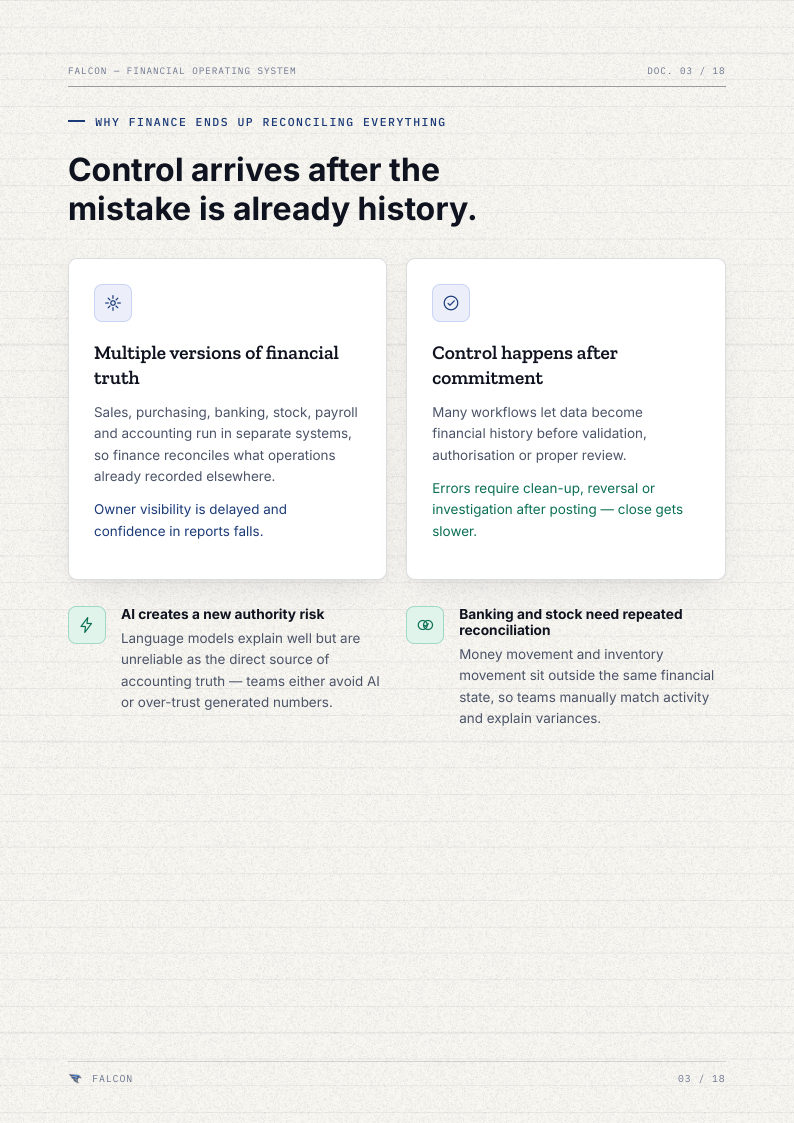
In many systems, the moment someone presses save, the entry becomes part of your accounts. It feels fast, and it is fast. But every check now happens after the mistake is already in the books. Errors have to be found, reversed and explained later. Month-end gets slower, because the accounts team spends it undoing what others already entered.
Put simply: the check comes after the mistake is already history.
Changes that are checked first
Falcon works differently. Important work goes through simple steps before it becomes final.
- Prepare. The entry is a draft. It can be changed, reviewed or thrown away.
- Check. Falcon checks it against business and accounting rules. Mistakes show up while they are easy to fix.
- Approve. Where you want it, a second person approves it.
- Record. Falcon's fixed rules put it into the books. Now it is final.
- Match. Recorded entries are matched with bank entries, stock and other records.
- History. Every important change keeps a record of who did it and when.
An entry is a draft until it is checked and approved. Only then is it recorded.
The same steps everywhere
What makes Falcon consistent is that these steps are not only for normal entries. They also apply to approvals, to moving in old data, and to anything the AI prepares.
Old data goes into a holding area, problems are fixed, and only then is it recorded. An AI action is drafted, previewed, checked for permission and confirmed before Falcon records it. Closing a month needs permission, and so does reopening it. Once your team learns the steps in one place, they recognise them everywhere.
Why this matters: fewer silent changes, clear responsibility, easier reviews, more confidence at month-end, and every number can be explained later.
Fast, but not careless
Does every check slow the business down? No. Your sales and store staff keep working the normal way. The checks sit at the point where daily work becomes official accounts, not in the way of the sales desk. In Falcon, faster does not have to mean careless.
The takeaway
If a system cannot show you the difference between a draft and a final entry, it has quietly chosen speed over control for you. Ask where the drafts are, who approves them, and what the history looks like.
See how Falcon keeps control or read how the same steps apply to Falcon AI.